
Why Your ATS Is Lying to You: Stale Candidate Data, Fragmented Records, and the Hidden Problem Killing Agency Productivity
An ATS tracks applicants; it was never built to keep candidate data fresh or hold your relationships. Here's why that gap costs placements, and how modern teams fix it.

Deep Singh
Principal Talent Engineer & Co-Founder, Effi Flo
By Deep Singh, Principal Talent Engineer and Co-Founder, Effi Flo
In short: An applicant tracking system is built to do one thing well: track applicants through a hiring process. It was never built to keep candidate data fresh, or to hold the relationships, calls, and outreach that live in your CRM and a dozen other tools. That gap is why a clean-looking pipeline quietly stops being true, and it costs placements: 46% of sourced hires now come from candidates already sitting in the database, and sourced candidates are nearly 8x more likely to be hired than inbound applicants. Across the 110+ recruiting teams Effi Flo has worked with, the biggest productivity leak was never the recruiters. The fix isn't a new ATS. It's using a platform that does both ATS and CRM, or building a living data layer that keeps the whole picture current.
An ATS does exactly what it was built to do. You put a candidate in, move them through stages, and it hands the record back on request. That's the job, and most do it well. The trouble starts when agencies treat that system of record as if it were a system of intelligence, something that keeps candidate data fresh, tracks relationships over years, and knows who's actually reachable today. It was never designed for any of that. So it keeps showing you a tidy pipeline long after the data inside stopped being true.
That's what we mean by a lying ATS. Not a broken product, a misused one. Across the 110+ recruiting teams we've worked with, the single biggest productivity leak wasn't the recruiters. It was the database they trusted. We talk to five to ten agency owners every week, and the pattern is the same: the dashboard looks healthy, the pipeline looks full, and then you try to use the data and it falls apart in your hands.
Here's what's actually happening, why, and what modern teams do about it.
Key Takeaways
- An ATS tracks applicants. It doesn't keep them fresh. A system of record was never designed to be a system of intelligence.
- A "full" pipeline is often a graveyard. Stale statuses, dead emails, and duplicates make the database look richer than it is.
- Relationship intelligence lives in your CRM, not your ATS. A good CRM tracks outreach and relationship strength. The problem is that even then, your data is fragmented across too many tools.
- Your best candidate is probably already in there, invisible because the data around them is out of date or badly tagged.
- This is why AI pilots stall. Point AI at stale, fragmented data and it makes confident mistakes faster.
- The fix isn't a new ATS. It's a living data layer on top of the stack you already run.
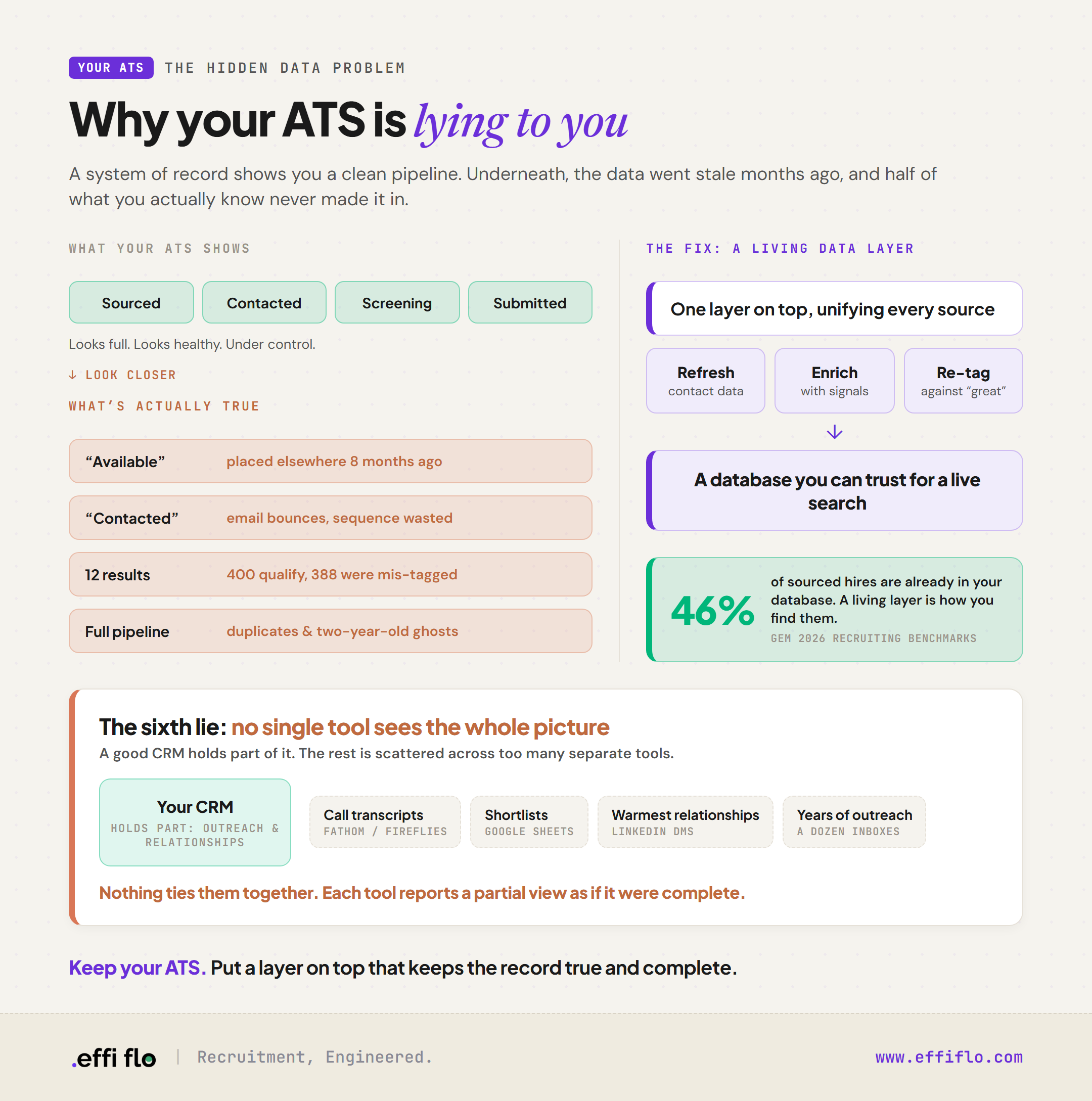 What your ATS shows versus what's actually true, and the living data layer that keeps the record current
The pipeline that looks full and isn't
You know this one already. The pipeline shows names at every stage, then you pull a shortlist for a live role and half of it is placed, unreachable, or mis-tagged. It was never as full as it looked.
That's the gap between a system of record and the reality it reports as fact. Your ATS isn't wrong about what you told it. It's wrong about what's true today, and it has no way of knowing the difference.
What is candidate data decay?
It's the slow drift of your candidate data out of date while the records never change. This is personal data, and personal data goes stale fast: a candidate changes jobs, an email gets retired, a phone number gets reassigned, a "hot" prospect goes cold. The record keeps showing the old version, formatted just as neatly as a fresh one.
The cause is structural, not sloppiness. Nobody edits the file; the world just moves on around it. Keeping that data current, re-verifying emails, refreshing who works where, enriching a profile with what's changed, is a job of a CRM or a data layer, not something applicant tracking was built to do. Run it forward across a database you've built over five or six years, and a large slice of it now describes people who have already moved on.
The six ways your ATS is lying to you
Here are the six we see most. One line each, because you already live these.
1. "Available" just means "available whenever someone last typed it." A status field has no concept of time.
2. "Contacted" points at dead addresses. The old email still shows, looking exactly as trustworthy as a good one.
3. Your best people hide behind bad tags. A search only returns what was labeled correctly on the way in.
4. The pipeline is padded with ghosts and duplicates. The count goes up; the usable pipeline doesn't.
5. Every metric inherits the rot. You plan capacity and BD from a dashboard describing a database that no longer exists.
6. It only sees a fraction of what you know, and so does your CRM. A good CRM already handles part of this, tools like Attio track last response, relationship strength, and outreach history. The real problem is fragmentation: even with a solid CRM, your intelligence is scattered across too many separate tools with nothing tying them together. The screening call sits in a Fathom transcript, the shortlist in a Google Sheet, the warmest thread in a LinkedIn DM, years of outreach across a dozen inboxes. No single system sees the whole picture, so each one reports a partial view as if it were complete.
What your ATS shows versus what's actually true
| What your ATS shows | What's actually true |
|---|---|
| "Available" candidate | Placed elsewhere eight months ago |
| "Contacted" with a valid email | Email bounces, sequence wasted |
| 12 search results for the role | 400 qualify, 388 were mis-tagged |
| A full, healthy pipeline | Duplicates and two-year-old ghosts |
| Your complete candidate picture | Half of it lives in your CRM, calls, and inboxes |
| Clean productivity metrics | Numbers built on stale, partial data |
Why does this happen to almost every agency?
This is not your recruiters being sloppy, and it's not your ATS vendor failing you. An ATS is a system of record: it stores what you enter and hands it back on request, and most do that well. Keeping candidate data fresh, enriching records with live market signals, re-tagging old profiles against new roles, and pulling together the context scattered across your calls and inboxes are different jobs the category was never meant to cover. The word "almost" is doing real work here: a small desk you hold in your head is fine. At scale, this is close to universal.
This is exactly where AI hits a wall, and most agencies are about to. Among staffing firms that grew revenue more than 25% last year, 78% already run AI embedded in their ATS, per Bullhorn's 2026 GRID report. But only 10% have rolled AI across their full workflow, and the barriers they cite are data readiness and security. Point capable AI at a stale, fragmented database and it makes confident decisions on top of the rot, faster. The agencies pulling ahead fixed the data first.
"But can't I just clean it once?"
No, and it's worth knowing why before you spend the intern's month on it. A one-time scrub is accurate the day it finishes and starts decaying the next morning at the same rate, because the cause never went away. And it only ever touches one tool, not the context still trapped across your calls, sheets, and inboxes. Freshness isn't a project you complete. It's a process that has to run continuously.
You already own the placements you're missing
The candidate you need is usually already in your database. You sourced them once, spoke to them, maybe submitted them. Then the data around them decayed, they went invisible, and a recruiter paid to source someone new.
This is the norm. Gem's 2026 benchmarks found 46% of sourced hires now come from rediscovered candidates already in a company's CRM or ATS, up from 26% in 2021, and sourced candidates are nearly 8x more likely to be hired than inbound. Your own database is your highest-yield source, if you can actually find who's in it.
Our client Ilan Saks at Stacked SP described what that feels like once matching runs on data it can trust:
"You put in a job and a handful of hours later you got a list of a few hundred great candidates ready to go into campaigns. Huge savings, huge."
That speed doesn't come from a new ATS. It comes from data the system can finally trust.
The 15-minute self-audit. Pull the first 20 candidates your ATS marks "available" for a live role. Check each on LinkedIn: still in the same job, still reachable, still a fit? Count how many pass. Whatever number you get is the honest freshness of your pipeline, and it's usually a shock.
What actually fixes a lying ATS?
Solution 1: Use a platform that does both ATS and CRM
The first move is to stop asking an applicant tracker to manage relationships, and use a platform built to do both. Plenty of modern platforms now bundle ATS and CRM in one system. Before you look at any specific tool, know what separates a modern platform from a rebranded tracker. Ask:
- Can it enrich and re-enrich talent and company profiles? How does it keep your data fresh over time, and at what cost?
- Can it catch signals about who's changing jobs and which companies are hiring? Most mainstream recruiting ATS and CRM platforms still don't do this natively. A few talent-intelligence platforms (Loxo, hireEZ) surface market-level hiring signals, and candidate job-change tracking is more mature in dedicated signal tools. If your platform doesn't catch these, you'd wire it up outside, in Clay or similar, when that intelligence is worth it to your business.
- Does it integrate with your other tools and platforms? Does it have an API or an MCP, and how good is the API?
- How well can you automate workflows inside the platform? Automated emails triggered when a candidate changes stage in your client's hiring process, internal actions triggered by events, that kind of thing.
- How steep is the learning curve, and how fast do they fix bugs? Have a few real conversations with their support before you commit, that tells you more than the demo.
Once you know what to ask, here are platforms worth comparing, by who you are:
- Staffing and recruiting agencies: Spott and Atlas, AI-native recruitment platforms with built-in CRM, built for agencies. (Atlas, for instance, leans on agentic AI to auto-enrich candidates and keep the database current, the exact gap this article is about.) Stardex is a strong option too, especially for executive search.
- In-house talent teams: Ashby, which combines ATS, CRM, sourcing, and analytics for high-growth and enterprise hiring teams.
- A flexible CRM + enrichment layer: Attio, an AI CRM that auto-enriches records and opens up via API, alongside the ATS you already run.
Compare, don't take one vendor's word. The right answer depends on your setup.
Solution 2: Build a unified data layer over your existing stack
The other path doesn't replace anything. You keep your ATS, your CRM, and your tools, and build an AI-native data platform on top that connects them, so your data lives in one place you own, not scattered across platforms you rent.
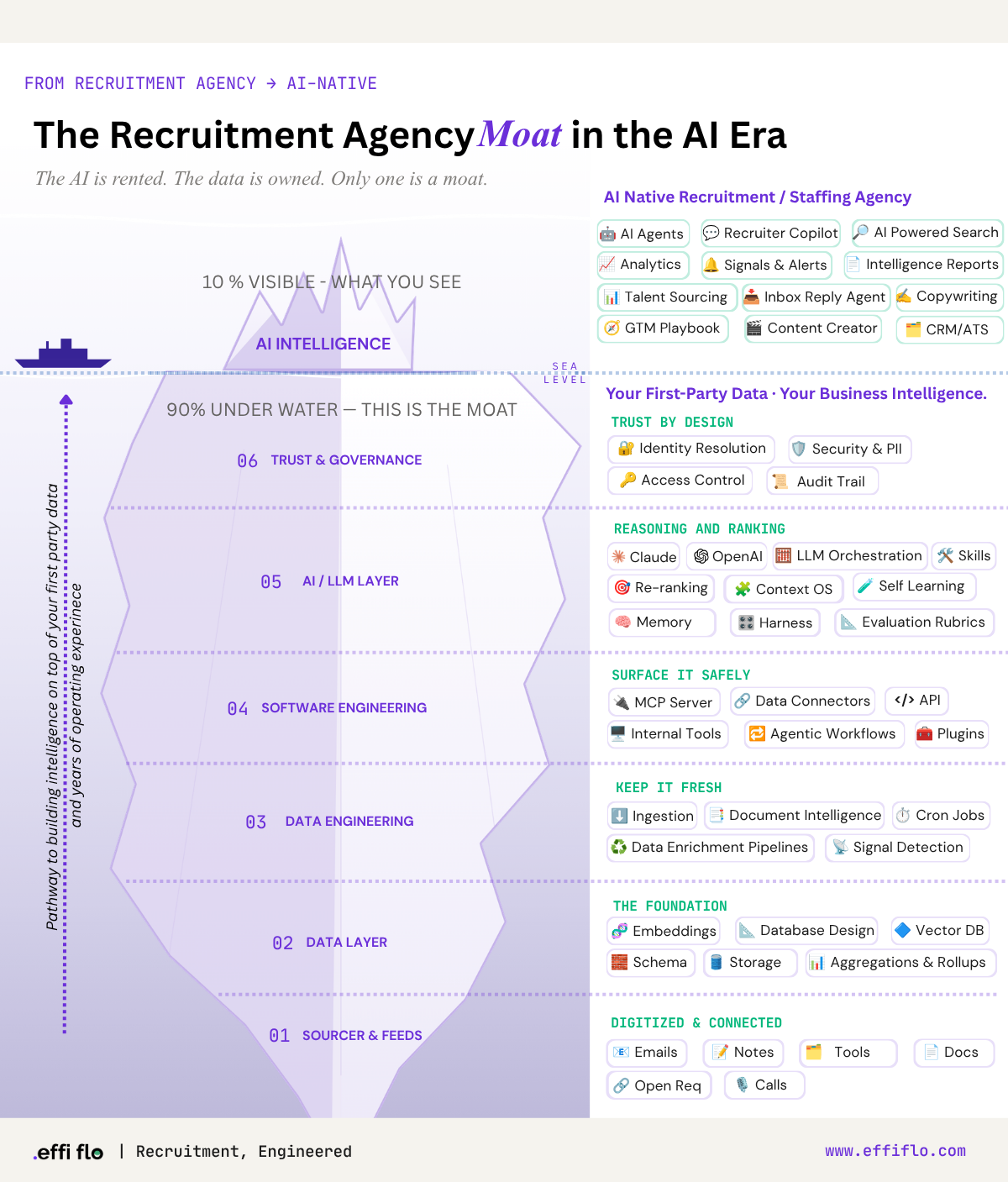 The AI on top is rented; the data layer underneath is what you own - your sources, unified, enriched, and kept true - the part competitors can't copy
That layer does three jobs no single tool covers: it refreshes candidate data on a schedule, enriches records with fresh signals about who's moving and hiring, and re-tags your existing database against a real definition of what "great" looks like for each role, drawn from Talent DNA Fingerprinting. The result is one current, complete picture your team and your AI can both reason over, without migrating anything.
The advantage of owning the layer is that your intelligence stays yours. The AI on top is rented; the data underneath is owned, and only one of those is a moat. You can build your own AI on that data later, keep it when you switch a tool, and grow it without handing your business intelligence to another platform.
This is real data-engineering work under the hood, which is exactly where we help. And being honest about the limits: a living layer is only as fresh as the providers feeding it. It closes most of the gap between your database and reality, not all of it. Most beats a record that never updates at all, by a wide margin. If you're weighing these two paths and aren't sure which fits, that's the conversation to have first.
When your ATS is fine as-is
Not every agency needs this. Running a small desk with a few hundred candidates you personally know? You're the freshness layer, and your ATS probably isn't lying to you in any way that matters. This is a scale problem. It shows up when you have years of candidates spread across more tools than any one person can track.
The bottom line
Your ATS isn't lying to hurt you. It's a system of record faithfully showing you a version of the truth that expired months ago, and only the slice that got typed into it. The productivity you're missing is sitting in the database you already own, behind data nobody keeps current and relationships no tool pulled together.
If you're evaluating your recruiting stack and aren't sure which path makes sense, using a platform that does both ATS and CRM or building a layer on top, we're happy to think it through with you.
Deep Singh is Principal Talent Engineer and Co-Founder of Effi Flo. He built and scaled his own recruiting agency, Canada Mentors, to seven figures before founding Effi Flo, a tech enablement firm that helps Staffing Agencies and Recruiting Teams implement AI and automation systems in their day-to-day operations.
Ready to automate your recruiting?
Book a 30-minute strategy session with Deep Singh to see how Effi Flo can transform your pipeline.
Book a free database auditFrequently Asked Questions
Related Articles
The 5-Layer AI Recruiting Stack for Staffing Agencies (2026)
After building recruitment automation systems for 110+ agencies, Effi Flo has mapped the exact tools and architecture behind the staffing firms that are scaling without growing headcount. Here's the 5-layer stack that actually works.
Claude Code for Recruitment: How Staffing Agencies Build AI-Powered Workflows Without a Dev Team
How staffing agencies use Claude Code in production recruiting stacks. 5 workflows Effi Flo runs across 110+ agencies, where each breaks, and how Claude Code fits alongside Clay, n8n, Supabase, and your ATS.
Talent Engineer: The Role Recruiting Was Always Going to Need
The title is arriving now. The work started years ago. Here is how it happened, what the role actually involves, and why staffing and recruitment agencies will need it most.