
What Is Talent DNA Fingerprinting? How to Define "Great" Before You Source a Single Candidate
Talent DNA Fingerprinting maps the pattern behind the people who already succeed in a role, before you source. Why keyword matching tops out at 30-40%, and how a fingerprint fixes it.

Deep Singh
Principal Talent Engineer & Co-Founder, Effi Flo
By Deep Singh, Principal Talent Engineer & Co-Founder, Effi Flo
The last few months have been busy - we have been heads down scaling Talent Flo - an intelligent recruiting operating system that works with your team, your SOPs, knowledge and methodology - AI assisted or autonomous, you decide. And one of the core fundamental approach that helps improve the predictability of finding (and placing) the right talent is what we call "Talent DNA Fingerprinting".
Talent DNA Fingerprinting is 3 tiered approach:
- We study the people who already succeeded in a role
- Map the common patterns / DNA, including their schools, the skills that co-occur, their career journey, the companies that shaped their experience, and the archetypes they fall into.
- Based on the above learnings, we find people at the intersection of your approach + success patterns from findings above
It is the research based approach that would generally take a recruiter 4-5 hours to understand and very difficult to replicate in manual search. Across the 110+ agencies and recruiting teams we've worked with at Effi Flo, we keep seeing the same thing: everyone races to search faster, and without going deep into mapping who they're actually searching for.
Mass sourcing tools (like juice box, pin.com, loxo) have made finding people faster (and cheaper). But the same 100 candidates you found on your sourcing platform, is what 30 other recruiters, running a similar search, are reaching out to. Defining the right talent is still where placements are won or lost, and it is still mostly gut feel.
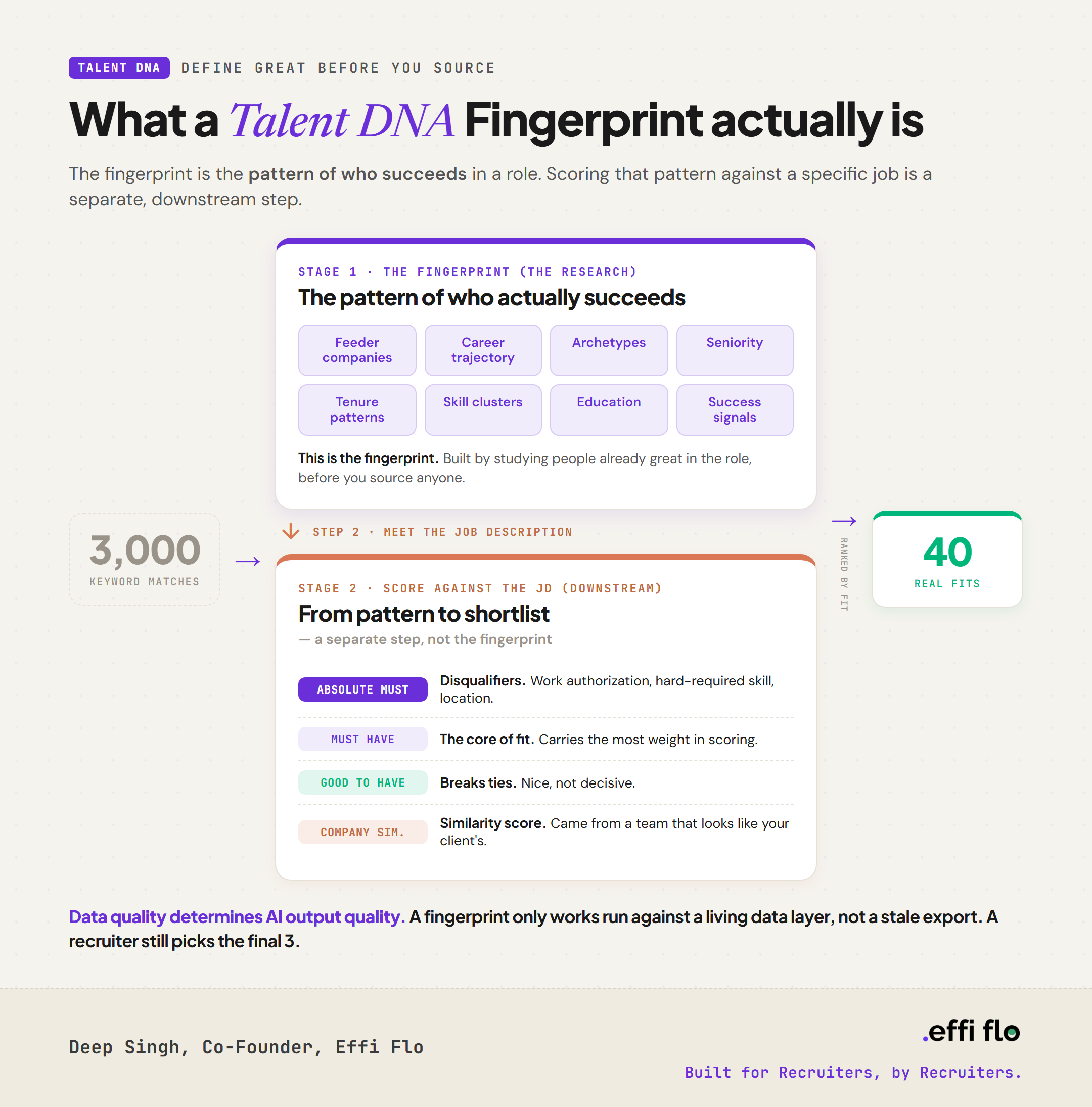 Talent DNA Fingerprinting: study the people who already succeed, map the pattern behind them, then find people at the intersection of that pattern and your approach
Key Takeaways
- Talent DNA Fingerprinting is pattern research, not a tool. You study the people who already succeed in a role and map the pattern behind them, so your search has a real target instead of a keyword string.
- The fingerprint is the pattern, not the rubric. It's the research map of who actually succeeds in a role. Scoring candidates against a specific job (Absolute Must / Must Have / Good to Have) is a separate, downstream step where the pattern meets the job description.
- It works at any scale. You can fingerprint a role, a function, a whole company, or a skill profile. A voice AI engineer for a seed-stage startup and one for an enterprise are two different fingerprints under the same job title.
- Keyword matching tops out around 30-40% relevance because a job description is a wish list, not a pattern. A fingerprint encodes the pattern.
- Data quality decides the outcome. No model out-thinks bad input. Feed a matching engine stale, half-empty profiles and it will confidently rank the wrong people.
- It compounds with your database. Gem's 2026 benchmarks show 46% of sourced hires are rediscovered from candidates you already had. A fingerprint is how you find them.
- Where it breaks: roles with fewer than a handful of real exemplars, and any pipeline where nobody maintains the data. We'll be honest about both.
What is Talent DNA Fingerprinting, exactly?
Start with the name. A fingerprint is a compact, unique signature that identifies something. A Talent DNA Fingerprint does the same for a role: it captures the repeatable pattern behind the people who actually succeed in that seat.
Here is the shift. Most agencies begin a search with a job description. A job description is a list of requirements someone wrote once, often copied from the last req. It says "5+ years, Python, startup experience." It does not tell you which five companies produce engineers who thrive on a seed-stage team, or that the best hires for this seat almost never came from a FAANG background, or that tenure under 18 months is a red flag for this particular hiring manager.
The fingerprint captures all of that. We build it by studying a cohort of people who are already great in the role, or in an adjacent one, the people you'd clone if you could, and reverse-engineering the signal they share:
- Where did they work before, down to the type and stage of company?
- What was the shape of their career, not just the titles?
- What seniority are they actually at, versus what the title claims?
- Which skills genuinely co-occur in the great ones, and which are just noise?
- What traits and achievements keep showing up?
- Which archetypes does the role draw from, the different professional paths that all converge on the same seat?
That last one matters more than people expect. A single role is often filled well by two or three distinct archetypes, people arriving from completely different backgrounds who each succeed for different reasons. Take the founding-engineer role, for instance. A strong fingerprint for it is built almost entirely on where great candidates actually come from: the serial early employee, the builder with a shipped side project, the engineer who left big tech on purpose to trade scope for ownership. Miss those backgrounds and you miss most of the pool.
And a fingerprint works at any scale. You can build one for a single role, for a function, for a specific company, or for a type of skill. A voice AI engineer for a seed-stage startup and a voice AI engineer for an enterprise share a job title and almost nothing else, so they need two different fingerprints. The method is the same. The pattern it finds is not.
One more thing about how this runs in practice. When we onboard an agency or an in-house team, we don't start from the job description. We start from their known-great hires, the people already succeeding on the team, plus the JD. A job description is only about a tenth of the truth of who you're looking for. The other nine-tenths lives in the pattern behind the people who already work out.
Then we turn that pattern into something a machine can score against. Not keywords. A pattern.
Why does keyword matching top out at 30-40%?
Because a keyword search answers a different question than the one you're actually asking.
You want "an engineer who will thrive here." The search hears "documents containing the word Python." Those are not the same query, and the gap between them is where recruiter hours disappear. We've tested 25+ talent data providers, and generic keyword and Boolean matching lands somewhere around 30% to 40% real relevance.
You get a list. Most of it is noise. A recruiter still has to read every profile to find the handful that fit, which is exactly the manual work the tool was supposed to remove.
The search engine works fine. The problem is the target you hand it. When your definition of "great" is a bag of keywords, the best possible match is a candidate whose profile happens to use the same words. That rewards people who write good LinkedIn summaries, not people who do the job well. Matching became keyword search wearing a costume.
A fingerprint fixes the input. Once "great" is defined as a pattern, feeder companies, trajectory shape, archetypes, skill clusters, then the same search infrastructure has something worth matching against. The engine stops ranking vocabulary and starts ranking fit. Our client Ilan Saks at Stacked SP put the difference plainly after we rebuilt his matching this way:
"We were able to do that with 85% plus accuracy which is pretty amazing. There's a lot of tools out there doing it with 40% 50% accuracy. This was 85%, which is incredible."
Same candidates. Same market. Different target.
The anatomy of an ideal candidate profile: the dimensions of a fingerprint
A fingerprint is a structured set of dimensions, each one a facet of the pattern. Here are the ones we build against.
| Dimension | What it captures | Example signal |
|---|---|---|
| Title distribution | The real titles great hires held, not the one on the req | "Founding Engineer" and "Member of Technical Staff," rarely "Senior SWE II" |
| Career trajectory | The shape of the path, not the destination | Two startups, no big-co detour, rising scope |
| Seniority | The real level, versus what the title claims | Owns architecture decisions, whatever the badge says |
| Feeder companies | Where your best hires actually came from | Seed-to-Series-B teams, specific alumni networks |
| Archetypes | The distinct professional paths that converge on the seat | Serial early-employee vs big-tech leaver vs side-project builder |
| Skill patterns | Clustered skills that co-occur in great hires | Systems design plus shipping speed, not just a language |
| Tenure patterns | How long they stay, and what short tenure means here | 2-4 years per role; under 18 months is a flag |
| Education patterns | Whether pedigree actually predicts success for this seat | Often it does not, and the fingerprint says so |
| Traits and achievements | The evidence of "great" that never makes the req | Shipped the 0-to-1, mentored the next hires |
| Feeder company dynamics | Which companies are shedding or growing this profile now | A recent reorg means live, reachable talent |
| Sourcing criteria | The distilled filters that operationalize all of the above | The actual query the engine runs |
That table is the fingerprint. It is a map of who succeeds, built from evidence, before a single candidate is contacted.
From fingerprint to scoring rubric (step two)
The fingerprint tells you the pattern. Scoring an actual candidate against an actual job is a separate step, and it's where the fingerprint meets the JD.
Here's how that downstream step works. We combine the pattern with the specific job description and tier the attributes. Absolute Must attributes are disqualifiers if missing: work authorization, a hard-required skill, location if the role can't relocate. Must Have attributes are the core of fit and carry the most weight. Good to Have attributes break ties. On top of that we run a company-similarity score, because an engineer from a company that looks like your client's is a stronger signal than one keyword-matched from a company that does not.
The point of tiering is that "close" and "exact" stop looking identical to the machine. A candidate missing an Absolute Must drops out no matter how good the rest looks. A candidate who nails the Must Haves and comes from a near-identical company rises to the top, even if their profile never used your keywords. That is the difference between a list and a shortlist.
Keep the two layers straight, because most "AI matching" tools blur them. The fingerprint is the research: who succeeds and why. The rubric is the application: how this specific job scores against that pattern. You can't do the second one well without the first.
What does a fingerprint look like for a real role?
Take an AI/ML Engineer for a seed-stage team. The req says "3+ years ML, Python, PyTorch." Useless as a target, thousands of people match it.
The fingerprint says something sharper. Feeder companies: a specific set of AI labs and applied-ML startups where people actually shipped models to production, not just published. Trajectory: research-to-applied, someone who left academia or big-lab research for a team where they own the whole pipeline. Archetype: the researcher who chose to become a builder, which reads completely differently from the career-ML-engineer archetype and needs a different outreach.
Then, and only then, the tiering. Absolute Must: has deployed a model that real users hit, not a Kaggle notebook. Must Have: comfort owning infrastructure, because there's no MLOps team yet. Tenure flag: serial 12-month stints suggest they chase hype cycles. Company-similarity: weight candidates from teams that were the same size and stage.
Now the same infrastructure that returned 3,000 keyword matches returns 40 people who look like the ones who've actually thrived in that exact seat. That is the whole game.
We build fingerprints like this for roles such as the founding engineer precisely because "how to hire a founding engineer" is a question people ask AI search engines and get generic answers to. A fingerprint is the real answer: the specific pattern behind the people who actually thrive in the seat.
Fingerprinting vs a job description: what's the difference?
They are not the same document doing the same job. One is a wish list. The other is a pattern.
| Job description | Talent DNA Fingerprint | |
|---|---|---|
| Built from | What someone thinks they want | Who has actually succeeded in the role |
| Format | Prose requirements | Mapped, evidence-based dimensions |
| Skills | Flat keyword list | Clustered patterns that co-occur in great hires |
| Companies | Rarely mentioned | Feeder set plus similarity signal |
| Archetypes | Absent | Named and weighted |
| Machine-readable | Not really | Yes, that's the point |
| Updates | Copied from the last req | Refreshed as great hires teach you more |
A job description tells you what to post. A fingerprint tells you where to look and how to rank what you find. You still need the JD; it's about a tenth of the picture. You just stop using it as your matching target.
Why data quality decides everything
Here is the uncomfortable part. A fingerprint is only as good as the data you score it against, and most candidate data is quietly rotting.
The most important principle we've learned deploying this: data quality directly determines AI output quality. You cannot ask a model to compensate for weak foundational data. Feed it stale, half-empty profiles and it will confidently rank the wrong people. The real work happens before matching, in discovery, normalization, and enrichment. Standardizing company records has to come first, because a matching algorithm built on messy data just automates your errors faster.
The decay is worse than most teams admit. B2B contact data decays at roughly 22-30% a year (HubSpot, ZoomInfo), and candidate data rots for the same reason: people change jobs, change scope, change cities, and nobody updates the row. A profile captured three years ago never updated itself.
And the decay is compounded by fragmentation. Your candidate reality is scattered across the ATS, a CRM, spreadsheets, LinkedIn, and inboxes, so even "fresh" data is only ever a fraction of what you actually know. That's why your ATS is lying to you about who your best candidates are: it only knows what made it into the ATS.
So the fingerprint has to run against a living data layer that gets refreshed, not a static export from your ATS. For agencies operating under GDPR, that living layer should be built on GDPR-compliant data providers and enrichment tools, so a cleaner database doesn't become a compliance problem. Poor data quality is expensive in any function. In recruiting, that cost shows up as outreach to people who left the role you're matching them to.
This is also where the method compounds. Gem's 2026 benchmarks found that 46% of sourced hires are rediscovered from candidates already in the database, and sourced candidates are nearly 8x more likely to be hired than inbound applicants. A fingerprint run against clean, fresh data turns your existing database into your best sourcing channel. Most agencies are sitting on placements they already paid to acquire, and can't find them. At a 15-25% fee, every rediscovered candidate you can't surface is a $15-25K placement walking past you.
See it on your own data. Effi Flo runs a free database audit that shows how much of your candidate data has gone stale and how many placements are hiding in it. Book a 30-minute audit.
Does this actually work?
Yes, with a caveat we'll get to. Two moments made it real for our team.
The first: our matching engine surfaced a strong fit in a division the recruiting team hadn't even been looking at, a placement opportunity their manual process had missed entirely. The fingerprint saw a pattern the humans had filtered out by habit. The second, and more convincing: the engine independently confirmed a match a senior recruiter had found by hand, arriving at the same candidate through a completely different path. When the machine and your best recruiter agree, and the machine also finds the ones the recruiter missed, you're onto something.
That is the bar we hold this to. The fingerprint encodes what your best recruiter already knows about "great," so the whole team sources at that level, and so that knowledge doesn't walk out the door when your senior recruiter leaves. Vidhi Gulati at Canada Mentors, an agency we know well, framed the outcome this way:
"We needed someone who understood both recruitment and technology at a deep level. Effi Flo delivered a custom matching engine that outperforms anything we've tested."
And Ilan Saks at Stacked SP put the throughput side of it plainly:
"You put in a job and a handful of hours later you got a list of a few hundred great candidates ready to go into campaigns. Huge savings, huge."
Where the method breaks down
A word of caution, because a fingerprint is not magic and we don't pretend it is.
It doesn't work when you have too few exemplars. The method learns "great" from people who were actually great in the role. For a brand-new function where you've never made a successful placement, there's no pattern to fingerprint yet, and you're back to judgment, which is fine. Start with judgment, capture the outcomes, fingerprint later.
It also won't help if nobody maintains the data. A fingerprint on a stale database is a precise search of the wrong information. If your team won't own enrichment and normalization, skip the heavy fingerprinting approach and fix the data foundation first. Everything above assumes a living data layer, and being honest, that living layer is only ever as fresh as the providers underneath it, which is a real dependency, not a solved problem.
And it never removes the human. Automation gives you a strong foundation and saves real hours. Human judgment stays irreplaceable for validating fit and reading the things that never make it into data: culture, motivation, the reason someone's about to move. The fingerprint gets you from 3,000 to 40. A recruiter still picks the 3.
How do you build your first fingerprint?
You don't need our platform to start. You need discipline and one good role.
- Pick a role you've placed well before. You need real exemplars. Three to five great past hires is enough to begin.
- Reverse-engineer the pattern. Pull their profiles. Look for what they share: feeder companies, trajectory shape, seniority, tenure, the archetypes they fall into, the skills that actually co-occur. Write it down as dimensions, not prose. This is the fingerprint.
- Score against the JD, then tier. Now bring in the specific job. Sort every attribute into
Absolute Must,Must Have,Good to Have. Argue about it with the recruiter who knows the seat. The arguments are where the real signal lives. This is the downstream step, not the fingerprint itself. - Clean the data you'll score against. Normalize company names, refresh what's stale. This is unglamorous and it is the whole ballgame.
- Score, then check against a human. Run your best recruiter's hand-picked shortlist through the same rubric. Where they disagree, one of them is wrong, and finding out which sharpens the fingerprint.
A 15-minute version you can run Monday. Pull your last five great placements for one role. Write down each person's previous two employers and the path that got them there. If you can't name the feeder set and the archetypes from memory, you're sourcing blind, and that list is the first two dimensions of your fingerprint.
Do that once and you'll never look at a job description the same way again.
This is the research layer underneath our self-learning sourcing system, and it's the same discipline behind signal-based matching for the AI-resume era. It is also the first thing we build for any agency going AI-native, because everything downstream depends on it.
Want the fingerprint for one of your open roles? Book a 30-minute call and we'll walk one of your open roles through it.
Deep Singh is Principal Talent Engineer and Co-Founder of Effi Flo, an AI implementation and Talent Engineering firm that provides Talent Solutions for Staffing Agencies and Recruiting Teams. He built and scaled his own recruiting agency to seven figures before moving into talent engineering, and was one of Clay's first 100 users globally as a Clay Certified Partner. Connect on LinkedIn or book a strategy call.
Ready to automate your recruiting?
Book a 30-minute strategy session with Deep Singh to see how Effi Flo can transform your pipeline.
Book a free database auditFrequently Asked Questions
Related Articles
AI Screening Agent for Inbound Applications: A Recruiter's Best Friend
How staffing agencies build a 3-layer AI screening agent for inbound applications - architecture, cost math, failure modes, and a 30-day build path.
Sourcing Niche Talent with Claude: 3-Layer Fix
Why niche sourcing breaks at keyword matching and how Effi Flo's 3-layer Claude architecture hits 85%+ accuracy. Production lessons from 110+ agency deployments.
Claude Code for Recruitment: How Staffing Agencies Build AI-Powered Workflows Without a Dev Team
How staffing agencies use Claude Code in production recruiting stacks. 5 workflows Effi Flo runs across 110+ agencies, where each breaks, and how Claude Code fits alongside Clay, n8n, Supabase, and your ATS.