
Talent Engineer: The Role Recruiting Was Always Going to Need
The title is arriving now. The work started years ago. Here is how it happened, what the role actually involves, and why staffing and recruitment agencies will need it most.

Deep Singh
Principal Talent Engineer & Co-Founder, Effi Flo
Key Takeaways
- A Talent Engineer builds the system other recruiters work inside. The output is capability, not placements.
- The title is upcoming rather than new. The work has been happening for years under other names, or none at all.
- Automation did not reduce the human part of recruiting for us. It funded it.
- The role arrived because both sides of the market broke at once. Authenticity and relationships are what stay scarce.
- Compensation data is thin. One posting banded it at $120K to $240K plus equity, which is a data point, not a benchmark.
- Staffing and recruitment agencies will feel this hardest, because they need GTM engineering and talent engineering fundamentals in one seat.
I was doing this job in 2020. It did not have a name.
I started my own recruitment firm in 2020 and we scaled it to seven figures without hiring ahead of the work.
That was deliberate. We wanted to stay founder-led. We also wanted to move fast and actually change the trajectory of people's careers by placing them into leading companies. Those two goals pull against each other unless something absorbs the difference.
I came into recruiting from tech. I had worked closely with product and operations teams across startups and scale-ups at different stages, and in every one of them efficiency was a standing KPI, not a project you ran once a year. That was the lens I brought into the equation.
What I found was an industry that was 80-90% manual.
I want to be careful with that sentence, because "manual" is doing two very different jobs inside it.
Some of that manual work is the job. Speaking to candidates. Mentoring someone through a decision they will live with for the next four years. Telling a candidate honestly that the offer in front of them is the wrong one. Building a relationship that pays off two roles from now. None of that should be automated, and I have never had any interest in trying.
The rest of it was different. Triage. List building. Re-keying the same candidate record between three places. Rewriting the same job description for the fourth time. Repeatable work, done by hand, because nobody had built the alternative.
So I built it. Not because anyone hired me to. Because the alternative was doing the same thing every week and watching the backlog grow anyway.
On the talent side, we automated sourcing and the screening funnel. On the business development side, we built targeted lists and ran automated outreach to the companies we could realistically help hire. The toolbox at the start was Zapier, Make.com, PhantomBuster, Notion and Airtable. At the time, that was the frontier.
Here is the part that matters, and it is the opposite of what most people assume automation does to recruiting.
We ended up with more time for people, not less.
We spoke to a lot of candidates. We invested heavily in those conversations. We could only do that with a lean team because the other half of the week had stopped consuming us. The systems did not replace the relationship work. They funded it.
Nobody called any of this talent engineering. The title did not exist. Neither did GTM engineer.
Then the ground moved twice
The first move was Clay, in late 2022 and early 2023, arriving alongside ChatGPT.
Clay changed the equation for me because it collapsed two things I had been doing in separate systems into one surface. Build a list of companies. Qualify them. Go deep on the signals I actually cared about. Orchestrate the outreach. Before Clay, that same workflow meant a spreadsheet, a handful of browser tabs and a great deal of copy-paste between them. LinkedIn and Smartlead were gaining momentum around the same time. n8n and Supabase came into the stack later, once we were past what no-code could hold.
The second move is the one people underrate, and it is the more consequential of the two.
The platforms stopped gatekeeping.
Every ATS and CRM worth naming is now shipping an MCP, opening up its API, offering a cloud connection. That is a genuine reversal. The original model was to lock the data and the user inside the product and make interoperability someone else's problem. Vendors have worked out that this position is no longer defensible, and the walls have come down fast.
Clay is what proved the pattern in go-to-market first. It gave builders, founders and anyone with even a bit of a technical mindset four capabilities that used to require an engineering team:
- Architect a solution end to end
- Integrate platforms that were never designed to talk to each other
- Use data to make decisions rather than to justify them
- Go deep enough on pain points to find an actual alpha
That is the GTM engineer, and the title followed the work rather than preceding it.
Recruitment is now getting the same four. Data has been democratized. There are platforms you can use to vibe code the ideal experience for a candidate, for a client, or for delivery. You can bring a vision to life with no formal engineering background at all. And if you want something production-ready rather than demo-ready, you can go further into proper data engineering, analytics and software engineering and build it the right way.
That is the ground the Talent Engineer stands on.
Why now: both sides of the market broke at the same time
This is the part I think most write-ups of the role miss, because they look at hiring teams and stop there.
On the candidate side, AI genuinely helped people. It helped applicants identify the right opportunities, tailor their resumes properly, and prepare for interviews far better than they used to. That is a real gain and it deserves to be said before the complaint.
But with any technology comes the devil in the room. Alongside the genuine applicants came the fake ones. A lot of what now goes on a resume is written to game the system rather than to describe the person.
That broke a layer the whole industry sat on. An ATS was primarily a keyword search. It identified the right applicants from text and patterns, and if the words were there, you surfaced. Anyone can produce those words now, nothing validates them, and so that layer is gone.
Then the auto-apply layer arrived. Browser-based agents, computer-use tools, an entire category of software that will apply on your behalf while you do something else. Used carefully, against roles you actually want, it removes a genuinely manual task and that is a good thing. Most people do not use it that way. It applies to any job that comes past, so applications go up and the ATS gets worse at identifying the right person at the same time. The entire layer is broken, and the recruiter is the one absorbing it.
Gem's 2026 recruiting benchmarks put numbers on the squeeze: recruiting teams are 14% smaller than in 2021, and applications per recruiter are up 93%. Roughly one in seven recruiters gone, roughly double the inbound.
On the employer side, the problem is harder and less discussed.
Finding the right talent has become more difficult, not less. Fake applicants and genuine applicants land on the same role, and the ATS cannot tell you which is which, because nothing on a resume proves the work behind it was actually done. Everyone is now working from the same pool with the same tools. Outreach has gone the way of cold email: AI-generated slop, right, left and centre. Some of it is genuinely good and well targeted, which makes the situation worse rather than better, because it raises the floor for everybody simultaneously. When every message is competent, competence stops being a differentiator.
So what is actually scarce?
Authenticity and relationships, I think, are what will matter from here, and the context behind both. There is a lot of noise now, and a lot of fear with it. When everyone can reach everyone, the only remaining edge is the quality of what you know about a person and the time you have spent on them.
Somebody has to own that. That somebody is a Talent Engineer.
So what does a Talent Engineer actually do?
Broadly: they integrate the platforms, ideate and architect the workflow that should exist, and drive both efficiency and a materially better experience for the candidate, the client and the hiring team.
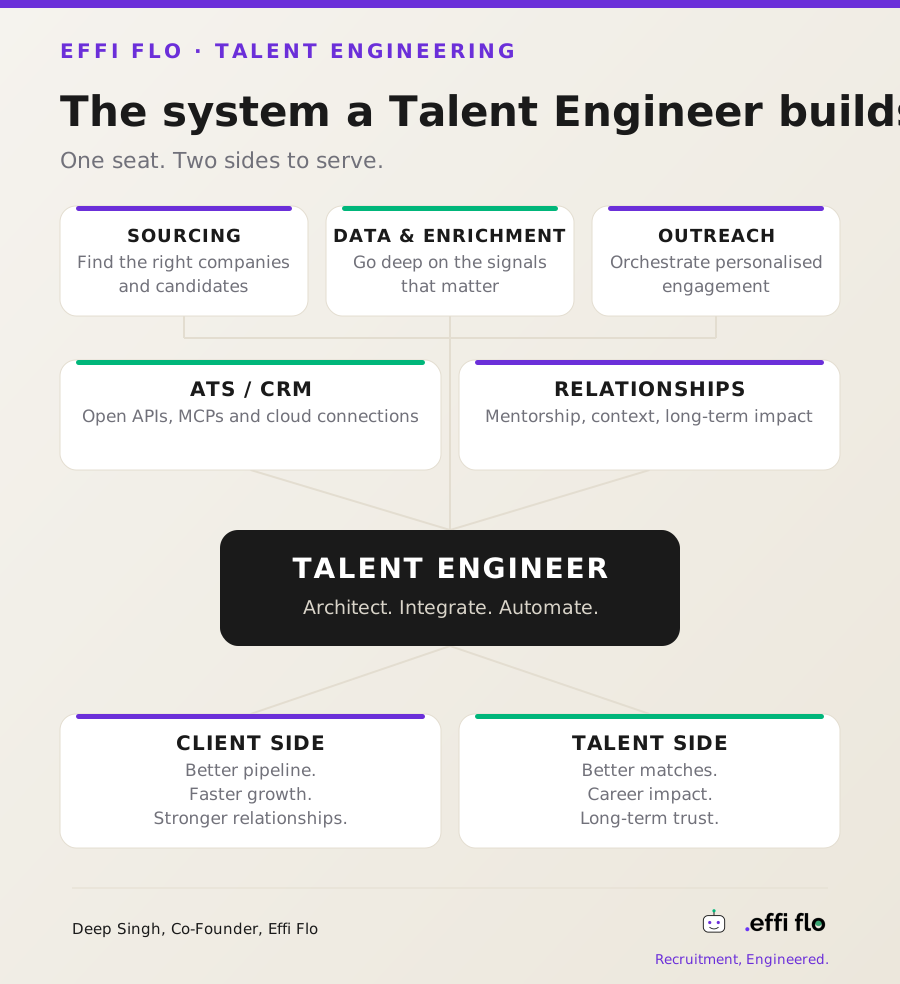 The system a Talent Engineer builds: sourcing, data and enrichment, and outreach, running on open ATS and CRM connections and on relationships, producing better pipeline and growth on the client side and better matches and career impact on the talent side
That definition is wider than the job postings suggest, and I think the postings are the wrong place to start. But they are useful texture, so here is what the ones I could find actually say.
xAI posted a Talent Engineer role in Palo Alto, on what the listing described as a small unit reporting directly to Elon. The framing was direct: you believe that "assembling high-performance teams is an engineering problem." The job was developing the systems to identify, engage and attract candidates, then executing against those systems end to end.
AirOps posted a Talent Engineering and Operations Lead, which is the clearest description of this job I have found anywhere. It asks for a recruiting operations expert who thinks like an engineer, someone who will design, build and maintain the automated systems powering the entire talent acquisition function, working at the intersection of sourcing, operations and engineering. The required skills listed were Clay, Claude Code, Cursor and v0. The line that does the most work:
Traditional recruiting ops scales processes. We want someone who can scale humans.
A separate AirOps mandate, for a GM of Talent Acquisition, was about turning founder-led ad hoc sourcing into a systematised function and building an AI-powered sourcing engine on Clay and Juicebox.
a16z runs an eight-week Talent Engineer Fellowship, admitting both engineers who recruit and talent leaders who build. I read the fellowship existing at all as a stronger signal than any individual job posting. Posting a role means one company has one gap. Running a programme means somebody is betting on a supply problem.
Metaview frames the split usefully: talent partners are judged on outcomes, talent ops on reliability, and Talent Engineers on capability.
| Role | Owns | Optimizes for | Fails when |
|---|---|---|---|
| Recruiter | Requisitions and candidate relationships | Placements this quarter | Applicant and role volume outrun the hours, because the screening is still manual |
| Recruiting ops | Process, reporting, system reliability | Consistency and compliance | The process is still manual, so it is slow and prone to error |
| ATS admin | Configuration inside a vendor's product | Uptime and correct setup | The product runs out of capability and cannot screen the volume or the tailored applications |
| Talent Engineer | The system recruiters work inside | Compounding capability | Builds tools nobody adopts |
On what they actually own, the least glamorous piece is the data layer: enrichment, validation, deduplication, and making sure the entries and the steps the older systems depend on actually get followed. It decides whether matching works at all. Matching accuracy is a function of data quality, consistency, freshness and depth long before it is a function of model choice, which is why an ATS full of stale records will quietly lie to you about what you have.
Depth is where AI has genuinely helped. An agent can research a company properly, work out what stage it was at when someone was there, and reason about what a given skill actually means, whether it is central to a role or secondary to it. That is context a keyword search never had.
On the technical bar, it is narrower than people assume. Comfort with APIs and a clear sense of where data actually lives. Enough logic to reason about a pipeline. A willingness to read documentation. A trained computer scientist is not the profile, and screening for one filters out the people most likely to succeed at this.
On money, there are very few public data points right now. The one confirmed band I have is xAI's $120K to $240K plus equity, and that is a single posting, at a frontier AI lab, in one of the most expensive markets in the world. Published averages for adjacent titles sit well below it: talent acquisition specialist around $67K on PayScale, recruiter around $84K and technical recruiter around $97K on Built In. I would expect the number to land between those two poles, and to move with the company, its stage and its growth. As the skill gets more in demand, I would expect it to go up.
There is a fair objection to all of this, and it comes from inside the industry: you do not need a new title, you need a new operating model. What happens when the tooling gets built and it still does not get you closer to a hire? That is the right failure mode to worry about. A Talent Engineer with no authority to change how people work will ship good tooling, watch adoption stall, and hand someone the evidence they wanted that AI does not work in recruiting. The tooling was fine. The mandate was missing.
This is not just happening to recruiting
Step back and the pattern is bigger than one function.
Go-to-market proved it first. GTM engineering is now an established discipline with its own tooling, its own community and its own career ladder, and it did not exist as a title five years ago.
Marketing is next and is less discussed than it should be, given how much is already happening there. A marketing engineer is a role I would expect to see posted within the year.
Product engineers have always existed. What is new is product managers shipping on their own, which is a different thing wearing a familiar name.
Security and compliance will follow as the models mature. I would be surprised if they did not.
The point is that talent engineering is not a recruiting curiosity. It is one instance of every function becoming engineering-first, and recruiting happens to be where I sit.
The ecosystem is the leading indicator, not the job boards
If you judge this title by job board volume, you will conclude it is barely real. That is a measurement error. Job boards lag. Titles appear in postings only after somebody has already been doing the work long enough for a company to write a requisition for it.
Communities lead. Here is where I would actually look.
PromptMates, co-founded by Joe Atkinson, previously Director of AI at Scede, and Jason Miller. It is a community for in-house recruiters, TA leaders and RecOps operators building real AI recruiting workflows, learning from practitioners at companies like Zapier, ElevenLabs and Lovable. Notably, one of the people featured in that community is building the full Talent Engineering function at AirOps, having previously shipped AI workflows at Vercel and Netflix. That is the same story showing up on two surfaces. The community and the job posting are not independent evidence, they are the same people.
Benjamin Mena, host of The Elite Recruiter Podcast, which is approaching 500k downloads, and organiser of virtual recruiting summits that have drawn 10k+ attendees, including the AI Recruiting Summit. He has done more than most to help this industry learn what AI actually does and does not do.
a16z's Talent Engineer Fellowship, as the institutional bet on supply.
Three job postings tell you a title is forming. A fellowship, a community and a summit series tell you a profession is.
Where this lands hardest: staffing and recruitment agencies
This is the part I have not seen written up anywhere, and I think it is the most interesting version of the role.
An agency is a double-sided business. You have a client side and a talent side, and both have to be fed continuously. An in-house team only has the talent side. That difference changes everything about what the role needs to be.
An agency needs GTM engineering fundamentals for business development: targeted list building, signal-based qualification, orchestrated outreach, pipeline visibility on the client side. It needs talent engineering fundamentals for delivery: the data layer, sourcing, matching, screening, candidate experience.
In an agency, those are not two people. They are one seat.
Call it what it is: a recruitment engineer. Not quite a talent engineer, not quite a GTM engineer, and stronger than either in isolation because the two halves share the same infrastructure. The enrichment layer that qualifies a client is the enrichment layer that qualifies a candidate. Building it once and using it on both sides is the entire advantage.
It is also, as far as I can tell, the widest career door currently open in this space. Someone who builds both sides can move into GTM engineering at a software company, or into in-house talent engineering, or stay and run an agency's entire operating system. Very few roles at this level of seniority give you that much optionality.
My prediction, clearly labelled as a prediction: demand for this will be higher in agencies than in-house, because agencies feel both constraints at once and have nobody to absorb them.
The bottom line
The title is upcoming, not settled. Anyone handing you a confident salary band is ahead of the evidence, and so am I if I pretend otherwise.
But the work is a separate question from the title, and on that the evidence is not thin at all. On most teams, somebody is already doing pieces of this between other jobs without owning any of it. That tells you more than a job board will.
One honest caveat: if your constraint is still headcount rather than volume, there is nothing yet for a built system to multiply. Wait until the same manual task shows up often enough across enough roles that building it once pays back a salary. If it already has, you probably know exactly who on your team has been quietly building it anyway.
If it would help to think this through with someone
We have built systems for 110+ staffing and recruitment agencies across the globe. That ranges from basic automation through to intelligent recruitment systems that do real heavy lifting: production-grade applications, proper databases underneath them, and AI intelligence layered in where it actually earns its place rather than where it demos well.
If we can help you point your effort in the right direction, we are always happy to chat.
Deep Singh is Principal Talent Engineer and Co-Founder of Effi Flo, an AI implementation and Talent Engineering firm that provides Talent Solutions for Staffing Agencies and Recruiting Teams. He built and scaled his own recruiting agency to seven figures before moving into talent engineering, and was one of Clay's first 100 users globally as a Clay Certified Partner. Connect on LinkedIn or book a strategy call.
Ready to automate your recruiting?
Book a 30-minute strategy session with Deep Singh to see how Effi Flo can transform your pipeline.
Book a callFrequently Asked Questions